For product developers, fabric suppliers, and eco-conscious brands, keeping sportswear fresh over repeated use is both a performance necessity and a market differentiator. Sweat, odor, and microbial buildup can shorten garment life and undermine brand quality, making effective hygiene solutions essential for competitive activewear lines.
This guide covers what antimicrobial treatments are, how they work against odor and bacteria, and durability and fabric care considerations, helping you select and implement solutions that boost garment longevity, safeguard wearer comfort, and align with sustainability goals.
What Are Antimicrobial Treatments?
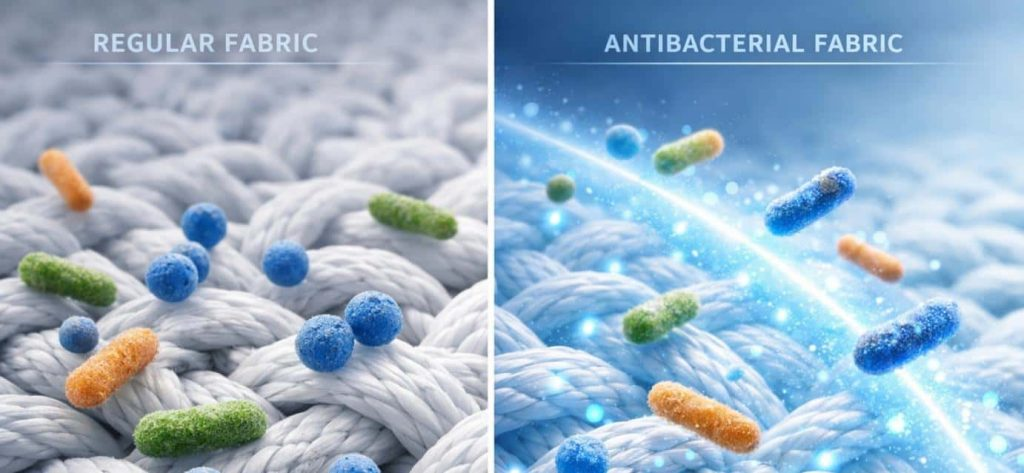
Antimicrobial treatments are processes or finishes applied to fabrics to inhibit or kill the growth of microorganisms such as bacteria, fungi, and viruses, thereby extending textile life and improving hygiene. These treatments are typically integrated during fabricación or as a finishing step, using agents like silver, zinc, chitosan, or plant extracts.
In our experience working with sportswear manufacturing, antimicrobial fabric treatment is a vital element in improving hygiene, comodidad, and product longevity, especially for performance textiles and activewear.
Definition and Purpose of Antimicrobial Treatments
Antimicrobial treatments are specialized textile finishing processes designed to prevent the growth of harmful microorganisms on fabric surfaces. They target bacteria, fungi, and viruses that can cause odor, deterioration, or health risks.
- Reduce unpleasant odors caused by bacterial growth
- Prevent mold and mildew formation in damp conditions
- Extend fabric lifespan by reducing microbial-related degradation
Common Application Methods and Agents
These treatments can be applied in several stages of fabric production, from fiber creation to post-manufacturing finishing. The method chosen affects durability, costo, and environmental impact.
- Additive incorporation during fiber spinning
- Surface coatings such as pad-dry-cure and plasma treatments
- Microencapsulation of active agents for controlled release
Common antimicrobial agents used in textiles include:
- Plata
- Zinc
- Copper
- Chitosan
- Quaternary ammonium compounds
- Aloe vera
- Essential oils
Performance and Benefits of Antimicrobial Treatments
High-performance antimicrobial finishes can inhibit up to 99.99% of microbial activity on treated fabrics. Technologies like Polygiene ViralOff™ showcase such efficiency in the sports and activewear market.
| Beneficio | Impacto |
|---|---|
| Odor reduction | Keeps garments fresher for longer, reducing wash frequency |
| Mold and mildew prevention | Avoids fabric damage and health hazards in humid environments |
| Extended fabric lifespan | Durable to over 15 wash cycles depending on treatment type |
In sportswear production, these benefits translate into longer-lasting products that maintain performance and appearance, aligning with both functional and sustainability goals.
Popular Technologies (Silver Ion, Zinc, Bamboo Charcoal)
Silver ion, zinc, and bamboo charcoal represent three distinct antimicrobial fabric treatment technologies. Silver ion leads the market with established industrial and consumer applications and strong growth. Zinc and bamboo charcoal serve smaller, emerging niche segments, with bamboo charcoal favored for eco-conscious textiles.
Antimicrobial fabric treatment technologies differ in performance, market maturity, and brand positioning. Product developers, fabric suppliers, and sustainable apparel brands often evaluate these options according to application requirements, costo, and eco-impact.
Overview of Silver Ion Technology
Silver ion technology holds a dominant market position, valued at $150 millón en 2025, with a 7% CAGR projected through 2033. It is widely used across industrial and consumer markets.
| Solicitud | Market Share | Notas |
|---|---|---|
| Industrial electroplating | 60% | Strong demand driven by regulatory water quality standards |
| Laboratory research | 30% | Used in precision measurement and antimicrobial testing |
| Medical uses | 10% | Applications in wound care and sterilization equipment |
The consumer segment shows strong expansion, with the silver ion toothbrush market worth $150 millón en 2025 and growing at 12% CAGR. Silver nanoparticles, a related technology, are projected to reach $10.3 mil millones en 2033, expanding at 13.8% CAGR across medical, electrónica, textiles, and water treatment applications.
- Market leaders: Hanna Instruments, Kalstein, Bante Instruments (industrial meters)
- Consumer brands: Jiangsu Sanxiao Group, Jiangsu Xingsheng Brush
- Growth drivers: tightening water standards, rising antimicrobial awareness, AI/IoT integration, Asia-Pacific production concentration
Zinc-Based Antimicrobial Treatments
Zinc-based antimicrobial fabric treatments remain an emerging niche with minimal quantified market data. En nuestra experiencia, zinc typically functions as a secondary agent, paired with silver or other treatments for enhanced performance.
- Zinc oxide nanoparticles applied in select textile lines
- Reduced market visibility compared to silver ion technology
- Cost-effective option for brands targeting lower production budgets
While zinc offers affordability, it lacks commercial maturity and deep market penetration, limiting its adoption in large-scale apparel manufacturing projects.
Bamboo Charcoal Technology in Textiles
Bamboo charcoal presents a sustainable, natural antimicrobial option with appeal to eco-conscious textile brands. Market data is unavailable, signaling a small but emerging segment.
- Antimicrobial effects derive from porous structure and carbon content
- Natural, biodegradable characteristics align with sustainable production goals
- Lower efficacy than silver ion or zinc-based treatments
This technology is often positioned in premium sustainability-focused products rather than in high-performance or medical-grade applications. Brands seeking to prioritize environmental responsibility over maximum antimicrobial performance frequently consider bamboo charcoal as a viable alternative.
How These Treatments Work Against Odor and Bacteria
These treatments target odor and bacteria using three main approaches: biological methods where microorganisms break down odor compounds; chemical processes that oxidize and neutralize odor-causing substances; and physical methods like adsorption to trap odor molecules.
Odor and bacterial control in textiles, especially for antimicrobial fabric treatment, relies on well-established scientific processes. En nuestra experiencia trabajando con ropa de alto rendimiento., each method addresses specific odor sources and contamination challenges.
Biological Treatments
Biological treatments rely on living microorganisms to degrade unwanted compounds. Systems like biofilters and biotrickling filters introduce targeted microbial strains to break down volatile organic compounds naturally.
- Use of microorganisms in biofilters and biotrickling filters to metabolize odor compounds naturally.
- Bioaugmentation enhances microbial populations for sustained long-term odor control.
These techniques align well with eco-conscious goals, as they avoid synthetic chemicals and can integrate into sustainable manufacturing pipelines.
Chemical Treatments
Chemical processes use oxidizing agents to react with odor-causing molecules and neutralize them. Oxidizers such as hydrogen peroxide rapidly degrade substances like hydrogen sulfide, converting them into less harmful compounds.
- Oxidizers like hydrogen peroxide break down hydrogen sulfide and other odor-causing chemicals into less harmful compounds.
- Chemical methods provide rapid odor reduction for acute contamination scenarios.
In textile production, these chemical treatments can be applied during finishing to deliver consistent antimicrobial effects across large-scale batches.
Physical Treatments
Physical treatments operate by capturing and removing odor molecules. Activated carbon adsorption leverages porous surfaces to trap volatile compounds, an approach widely used in air and water purification.
- Activated carbon adsorption captures odor molecules through porous surfaces.
- UV treatments can achieve significant odor reduction (arriba a 80%) under controlled conditions.
For sportswear manufacturing, combining physical adsorption with UV exposure enhances odor control without introducing chemical residues, supporting skin safety and sustainability goals.
Transform Your Sportswear Vision into Performance-Driven Reality
Partner with Sansan Sports to leverage cutting-edge technology and sustainable innovation for customizable, high-quality apparel tailored to your brand’s exact needs. Experience seamless design-to-delivery manufacturing that scales with your growth and elevates your market presence.
Natural vs. Chemical Antimicrobial Options
Natural antimicrobials like plant extracts and essential oils are safer and more environmentally friendly but generally less effective than chemical biocides, which deliver faster and greater microbial reductions. Natural options may require higher concentrations or longer contact times for moderate disinfection.
When selecting an antimicrobial fabric treatment, product developers and fabric suppliers often weigh performance against environmental and skin safety. En nuestra experiencia, natural agents are favored by eco-conscious brands, while chemical treatments dominate high-performance applications.
Comparative Efficacy of Natural and Chemical Antimicrobial Agents
| Agent | Tipo | Disinfection Efficiency | Log10 Reduction | Performance Notes |
|---|---|---|---|---|
| Hydrogen Peroxide (3%) | Chemical | 97.6–98.4% | >5 log10 | Effective broad-spectrum disinfectant |
| Clorox / Lysol | Chemical | >99% | >5.6–8.2 log10 | Effective against viruses like poliovirus |
| Ethanol | Chemical | >99% | >5 log10 | Rapid kill rate on most microbes |
| Vinegar (100%) | Natural | 83.2% | <3 log10 | Moderate efficacy, longer contact needed |
| Rose Water | Natural | Bajo | <3 log10 | Weak antimicrobial activity |
| Peganum harmala Extract | Natural | Medium | <3 log10 | Moderate disinfectant effect |
Natural biocides generally require higher concentrations or longer exposure times compared to synthetic biocides. This impacts treatment cycles and might affect production throughput for apparel manufacturers.
Durability and Fabric Care Considerations
Durability of antimicrobial fabric treatments is measured by their antibacterial effectiveness after 5, 25, o 50 home washing cycles according to standards like ASTM E3162-18 and AATCC 100. Following recommended washing protocols is essential to preserve both antimicrobial efficacy and fabric integrity.
For brands investing in antimicrobial fabric treatment, understanding how performance holds up over time is critical. Testing standards offer data-backed insight into how a textile retains its antibacterial properties after repeated laundering.
Durability Testing and Standards
Industry-standard durability testing evaluates treated fabrics after set wash cycles such as 5, 25, y 50. ASTM E3162-18 sets these benchmarks to create consistent parameters for antimicrobial performance measurement.
- ASTM E3162-18 – durability benchmarks after multiple wash cycles
- AATCC 100 – quantitative bacterial reduction measurement
- ISO 20743 – international antibacterial activity standard
- ASTM E2149 – dynamic contact antimicrobial evaluation
- Simulated laundering sometimes uses a single 45-minute cycle to represent several home washes
Fabric Care Practices to Maintain Antimicrobial Performance
En nuestra experiencia, care protocols directly affect the longevity of antimicrobial finishes. Proper washing reduces deterioration and ensures consistent hygiene protection.
- Use detergents that prevent cross-contamination and leave minimal residue
- Avoid harsh detergents and high-temperature washes to reduce finish degradation
- Align care labels with the specific antimicrobial technology used in production
Safety and Toxicity Considerations
Responsible sourcing goes beyond performance; safety compliance ensures skin comfort and regulatory alignment. Buyers should review both toxicity data and third-party certifications before purchasing treated fabrics.
- Taiwan CNS 14945 – requires no skin irritation with pH below 2, no allergic reactions, and low acute toxicity at doses above 1,000 mg/kg in animal tests
- ISO 20743 and OEKO-TEX – verify antimicrobial efficacy and consumer safety
- B2B buyers should request post-wash efficacy data and official safety documentation
Preguntas frecuentes
What is antimicrobial treatment?
Antimicrobial fabric treatment is a specialized finishing process that inhibits the growth of bacteria, mold, and odor-causing microbes on textiles. En nuestra experiencia, this is achieved using agents that bond to the fabric surface or integrate within the fiber itself.
This process is widely applied to sportswear, medical uniforms, and hygiene-sensitive apparel to enhance freshness and extend product life.
¿Es seguro para la piel??
High-quality antimicrobial treatments designed for apparel are tested to meet global safety standards such as OEKO-TEX®. These certifications confirm that treated fabrics are free from harmful levels of substances that can cause irritation.
For sensitive skin or children’s products, brands can request hypoallergenic formulations to ensure maximum comfort and safety.
How long does it last?
Durability depends on the treatment method, wash frequency, and fabric type. Modern antimicrobial finishes can remain effective for up to 50 wash cycles without significant reduction in performance.
Embedded treatments within synthetic fibers generally last longer compared to surface coatings, making them ideal for high-use sportswear and uniforms.
What are eco-friendly options?
Eco-conscious antimicrobial solutions include plant-based agents, recycled polyester integration, and treatments that use non-toxic minerals. These reduce environmental impact while maintaining fabric hygiene.
- ✅ Bio-based antimicrobial coatings from renewable sources
- ✅ Integration with organic cotton or bamboo fiber fabrics
- ⚠️ Compliance with biodegradable chemical standards
What standards exist?
Leading textile safety and performance standards for antimicrobial treatments include ISO 20743 (antibacterial activity test), OEKO-TEX® Standard 100, and BSCI for ethical production.
Brands working with Sansan Sports can ensure compliance with these certifications, guaranteeing both product performance and consumer safety.
Pensamientos finales
Antimicrobial fabric treatments have moved beyond a niche innovation to become a critical driver of performance, durabilidad, and brand differentiation in sportswear. From silver ion technology’s proven efficacy to emerging eco-friendly alternatives, the right selection balances hygiene, comodidad, and environmental goals. Integrating treatments that reduce odors, inhibit microbial growth, and withstand repeated laundering allows brands to deliver products that meet both athletic and sustainability demands.
For product developers and fabric suppliers, aligning high-performance antimicrobial solutions with responsible sourcing and certified safety standards strengthens market appeal and consumer trust. Partnering with experienced manufacturers ensures that technical requirements, cumplimiento normativo, and sustainability targets are met without slowing production cycles—positioning your apparel line to stay competitive in a rapidly expanding performance wear market.