European and U.S. apparel procurement teams face ongoing pressure to secure competitive pricing from China without sacrificing quality or exposing their brands to supply chain instability. Tariffs, より長いリードタイム, and stricter compliance standards make balancing these priorities increasingly complex.
This guide covers key cost drivers beyond factory price, proven quality control frameworks, and strategies for mitigating supply chain risk, helping procurement leads optimize sourcing decisions while maintaining compliance, reliability, and margin protection.
Cost drivers beyond factory price
Cost drivers beyond factory price in semiconductor manufacturing include equipment depreciation, facility construction, energy consumption, maintenance, 材料, labor, and supply chain complexity. These factors can add billions in total cost of ownership and significantly impact per-unit chip pricing.
私たちの経験では, understanding semiconductor costs means looking far beyond the headline factory price. Real-world production budgets are shaped by capital investment, ongoing operational expenses, and regional market forces.
Key Cost Components in Semiconductor Manufacturing
- 🏗 Facility construction cost for a 3nm fab estimated at $15–$20 billion.
- ⚙️ EUV lithography equipment cost approximately $350 百万 per machine.
- 💰 Depreciation cost of about $5,000 per wafer.
- ⚡ Annual power consumption costing between $100 百万 そして $300 百万 per fab.
- 🛠 Operating costs around $1.5–$2 billion per year.
- 📏 Mask sets and tape-out costs can exceed $100 百万 per chip design iteration.
These figures show how quickly costs escalate when accounting for advanced equipment and energy requirements. Beyond hardware, the human resource and maintenance allocations form a substantial part of total spend.
Regional Variations and Supply Chain Impact on Costs
| Region | Cost Adjustments | Impact Icon |
|---|---|---|
| 私たち. | まで 35% higher operating costs than Taiwan due to labor and utility. | ⚠️ |
| ヨーロッパ | Higher energy costs but lower labor expenses, balancing against U.S. facilities. | ✅ |
| Supply Chain Factors | Tariffs, regulatory compliance, and logistics create unpredictable cost swings. | ⚠️ |
Supply chain complexity can add both direct costs and risk exposure. Variations in tariffs or policy shifts often require agile procurement strategies to maintain budget stability.
Critical Perspective on Factory Price vs Total Cost
- 💡 Factory price represents only a fraction of the overall cost structure.
- 🏦 Capital investment and depreciation account for a large share of ownership expenses.
- ⚡ Energy, maintenance, and high-quality materials significantly raise per-unit pricing.
- ✅ Procurement teams should include these drivers when assessing total landed cost and supply reliability.
When sourcing, ignoring these drivers can lead to underestimated budgets and operational strain. Accurate evaluation means mapping all expense layers into decision-making, not just the invoice price.
品質管理: standards and inspections
Quality control in the European and U.S. automotive sectors is governed by rigorous international standards—most notably IATF 16949, ISO 9001, and the newly updated Euro 7 regulations—enforced through multi-stage inspections, production conformity checks, and in-service surveillance to ensure compliance, 安全性, and environmental performance.
In automotive sourcing, especially for brands working under European and U.S. regulations, quality control isn’t just a regulatory tick-box. It is a continuous framework of standards, inspections, and compliance cycles that protect safety, environmental performance, and market access.
Key Quality Standards in Automotive Manufacturing
The automotive sector operates under strict international quality management systems. 私たちの経験では, procurement teams sourcing critical components must align suppliers with the latest standards or risk product exclusion from regulated markets.
- ✅ IATF 16949: Sector-specific automotive quality management standard, mandatory for Tier 1 suppliers.
- ✅ ISO 9001: Baseline global quality management system covering a wide range of industries.
- ⚠️ Euro 7: Stricter emission and lifecycle compliance standard mandatory from November 29, 2026.
- ✅ UN R.013 そして UN Regulation No. 100 amendments: New safety requirements for braking and electric vehicles effective from September 26, 2025.
Inspection and Conformity Requirements
Compliance demands multi-stage inspection processes throughout the entire production chain, from material receipt to final vehicle delivery.
- ✅ Coverage includes incoming material, in-process checks like torque and weld integrity, and end-of-line functional tests.
- ⚠️ Euro 7 mandates production conformity, in-service conformity, and continuous market surveillance.
- 🚀 Enhanced On-Board Diagnostics (OBD) enable real-time emission monitoring throughout the vehicle’s lifecycle.
- ❌ Certificates of Conformity are invalidated for non-compliant vehicles starting January 1, 2027.
Implementation Timelines and Certification Cycles
Regulatory enforcement follows a clearly defined schedule. Missing these deadlines can lead to blocked market access and costly recalls.
| 📅 Date | Requirement |
|---|---|
| September 26, 2025 | Updated safety standards (UN R.013 & いいえ. 100) enforcement |
| November 29, 2026 | Euro 7 mandatory for all new vehicle types |
| November 29, 2027 | Euro 7 compliance for all new vehicle registrations |
| July 1, 2030 | Euro 7 deadline for small-volume manufacturers |
| January 1, 2025 | IATF 16949 6th Edition fully implemented; audits every 3 年 |
Critical Perspectives on Quality Control in Sourcing
Certification is the foundation of compliance, but it is not a guarantee of product integrity. Our procurement audits have shown that ongoing supplier evaluation prevents late-stage failures.
- ⚠️ Certification alone does not ensure quality; continuous supplier audits and corrective actions are essential.
- ✅ Procurement should prioritize suppliers with current certifications and transparent processes to keep pace with regulatory changes.
- ❌ Poor quality control can result in invalid certificates, blocked access to EU/U.S. markets, and costly recalls.
- 💡 Digital traceability, random batch testing, and risk-based management strengthen defect detection and drive continuous improvement.
Supply-chain risk: delays, tariffs, disruptions
Supply chain risks in 2025 are dominated by delays, tariffs, and disruptions, with average delivery times 25% longer than pre-pandemic, a 27% annual chance of major disruption, and new tariffs significantly increasing costs and complexity for apparel brands sourcing from China.
Global apparel sourcing, particularly for European and U.S. brands working with Chinese suppliers, faces a new reality where shipping delays, shifting tariff policies, and climate-related disruptions define cost and delivery outcomes. These risks directly influence procurement decisions and long-term supplier strategies.
Key Supply Chain Data and Metrics
| 📊 メトリクス | データ | インパクト |
|---|---|---|
| Average daily cost of disruption | $1.5 百万 | ⚠️ Significant financial strain for prolonged events |
| Lead time China → U.S. | 45+ 日 (50% 増加) | ❌ Longer inventory holding and capital lock-up |
| Raw material delivery | 81 日 (25% longer) | ⚠️ Planning and procurement cycles extended |
| Major disruption probability | 27% 毎年 | ⚠️ High risk for continuity and delivery schedules |
| European shippers disrupted | 76% で 2024 | ❌ Widespread impact across the region |
| Climate change-related disruptions | 63% で 2025 | ⚠️ Increasing unpredictability in logistics |
Critical Perspective on Structural Risks
私たちの経験では, apparel supply chain delays and longer lead times have shifted from occasional issues to embedded structural challenges. This forces brands to plan with extended timelines and maintain higher safety stock to absorb potential impacts.
- ⚠️ Tariffs on Chinese imports have increased costs and complexity, with rates projected up to 30% による 2026, driving supplier diversification.
- ⚠️ Climate change already affects 63% of companies, introducing unexpected logistics obstacles.
- ❌ Labor shortages strain operational stability and slow digital transformation projects.
Leading firms are adapting by boosting IT spending to 82%, applying strategic inventory buffers, and expanding supplier networks across multiple geographies. Without these measures, brands risk higher costs, 収益損失, and diminished customer trust.
Partner with Experts to Elevate Your Custom Activewear Brand
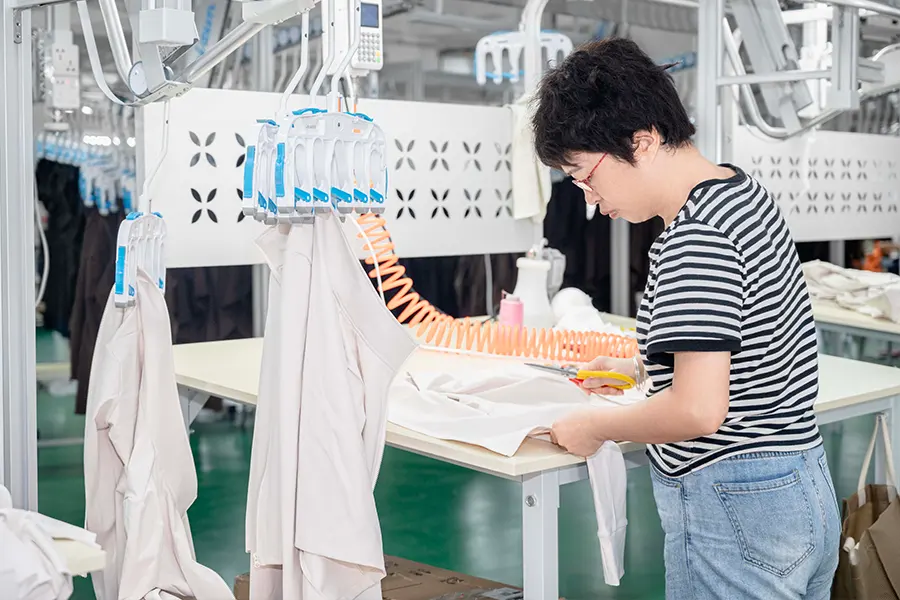
Unlock unmatched flexibility and quality through Sansansun’s dual-factory advantage, innovative design team, and sustainable materials. Start creating premium, trend-responsive activewear collections that scale with your brand’s unique vision.
Balancing low cost vs speed vs flexibility
Balancing low cost, スピード, and flexibility in European and U.S. apparel sourcing from China requires trade-offs: lowest-cost solutions usually mean longer lead times and less agility, while faster, more flexible supply chains typically incur higher costs and need advanced logistics partnerships.
In apparel sourcing, every brand must decide how to balance price advantages against delivery time and responsiveness. Our experience in working with European and U.S. procurement teams shows that these choices impact profitability, market agility, and customer satisfaction directly.
Comparison of Low Cost, Speed-Focused, and Flexibility-Focused Sourcing
| Sourcing Model | Typical Unit Cost | Lead Time | MOQ | Logistics Cost | Change Handling | Risk Profile |
|---|---|---|---|---|---|---|
| Low Cost ❌ | $1.50–$2.00 | 45–60日 | 1,000–5,000 units | $0.20–$0.35/unit | ⚠️ ≥2 weeks | ⚠️ Higher risk of delays, limited customization |
| Speed-Focused 🚀 | $2.20–$3.00 | 15–30 days | 500–2,000 units | $0.40–$0.60/unit | ✅ 1 week | ✅ Lower risk, プレミアム価格設定 |
| Flexibility-Focused 💡 | $2.00–$2.80 | 20–40 days | 200–1,000単位 | $0.30–$0.50/unit | ✅ 2–4日 | 💡 Moderate risk, high adaptability |
Challenges and Trade-Offs in Sourcing Strategies
- ❌ Low-cost sourcing suits standardized high-volume apparel but risks overstocking, delayed launches, and weak trend responsiveness.
- 🚀 Speed-focused sourcing ensures rapid replenishment and market agility, yet increases per-unit and freight costs, reducing margin buffers.
- 💡 Flexibility-focused sourcing handles frequent style changes and small MOQs, ideal for unstable demand but requires complex supply coordination.
- ⚠️ Few Chinese suppliers excel in all three — even advanced factories like ours still face unavoidable trade-offs between these priorities.
- ✅ Best practice: segment your product range by cost, スピード, and flexibility goals, then match each segment with the right supplier capability.
At Sansan Sports, we integrate OEM, ODM, and private label services so brands can mix sourcing models across different product categories. This way, procurement teams avoid one-size-fits-all suppliers and adapt sourcing to real business needs.
Real-world brand examples (US/EU)
Several leading European and U.S. apparel brands successfully manage cost, 品質, and risk when sourcing from China by establishing long-term partnerships and ensuring strict quality controls. Below is an overview of Sansan Sports alongside notable external brands exemplifying these strategies.
1. Sansan Sports Manufacturing Specializations
Sansan Sports specializes in custom sportswear and performance apparel manufacturing for global brands through OEM, ODM, and Private Label services. Operating in China, the company tailors solutions to a variety of business models from startups to professional teams.
Their flexible production supports low minimum order quantities (MOQ), facilitating rapid prototyping and small batch runs — ideal for emerging brands and private label businesses. Sansan Sports upholds rigorous quality and sustainability standards, 含む ISO, BSCI, そして エコテックス 認証.
- 🚀 Flexible MOQ suitable for startups and small runs
- 🚀 Fast sampling and flexible production
- ✅ Strict quality assurance and sustainability certifications
- ⚠️ Focus on B2B apparel manufacturing clients
2. アディダス
Adidas sources about 25% of its apparel products from China and maintains partnerships with over 10 long-term factories. The brand emphasizes strict quality controls and compliance through ISO 9001 そして BSCI 監査.
Adidas balances cost and quality effectively by leveraging its established supplier network and auditing processes.
- ✅ Strong long-term factory partnerships
- ✅ Comprehensive quality and social compliance audits
- ✅ Balanced sourcing strategy
- ⚠️ Higher complexity in managing a large supplier base
3. H&M
H&M sources roughly 20% of its clothing from China, working with more than 50 suppliers. The brand conducts annual sustainability audits focused on environmental and social governance to ensure ethical production.
This extensive supplier network allows for risk mitigation while maintaining cost efficiency and compliance for the global fast-fashion market.
- ✅ Extensive supplier network bringing flexibility
- ✅ Strong focus on sustainability audits
- ✅ Effective risk diversification
- ⚠️ Managing quality variations across many suppliers
4. PVH Corp (Calvin Klein, Tommy Hilfiger)
PVH Corp sources around 15% of its apparel from China, partnering with over 30 factories. It enforces high standards through 包む そして ISO 14001 certifications to comply with social and environmental regulations.
The company uses strict controls and long-term partnerships to ensure quality and sustainability across its Calvin Klein and Tommy Hilfiger brands.
- ✅ Robust compliance with environmental and labor standards
- ✅ Strong factory partnerships
- ✅ Integrated quality management
- ⚠️ Smaller sourcing proportion may limit leverage with suppliers
5. ナイキ
Nike sources roughly 10% of its apparel from China and collaborates with 20+ suppliers. The brand integrates advanced quality control systems and technological tools to maintain product excellence.
Nike’s focus on innovation and quality is reflected in its supplier relationships and controls, supporting consistent performance delivery globally.
- ✅ Use of advanced quality control technologies
- ✅ Strong supplier collaboration
- ✅ Well-established global brand reputation
- ⚠️ Smaller volume sourcing from China compared to competitors
6. Zara (インディテックス)
Zara sources about 12% of its apparel from China, with partnerships covering 40+ suppliers. The brand emphasizes strict compliance checks and fast fashion responsiveness.
This balance of cost and quality within a diversified supplier base helps meet quick turnaround demands in the global market.
- ✅ Strong compliance monitoring
- ✅ Large and diverse supplier network
- 🚀 Agile production suited for fast fashion
- ⚠️ Complex supply chain management due to high supplier count
| Brand | % Apparel Sourced from China | いいえ. of Suppliers | Certifications / コンプライアンス |
|---|---|---|---|
| サンサンスポーツ | カスタム, 柔軟なMOQ | Flexible network | ISO, BSCI, エコテックス |
| アディダス | 25% | 10+ | ISO 9001, BSCI |
| H&M | 20% | 50+ | Sustainability ESG audits |
| PVH Corp | 15% | 30+ | 包む, ISO 14001 |
| ナイキ | 10% | 20+ | Advanced QC tech systems |
| Zara (インディテックス) | 12% | 40+ | Compliance checks |
Building long-term partnerships with Chinese suppliers
Building long-term partnerships with Chinese suppliers is increasingly critical for European and U.S. apparel brands seeking to manage cost, 品質, and risk, as supply chain integration and collaboration now extend beyond transactional procurement to include joint innovation, localized production, and strategic alliances.
For apparel procurement leads in Europe and the U.S., developing deep supplier relationships in China extends far beyond price negotiation. These partnerships now involve coordinated production planning, shared innovation, and proactive compliance management to ensure performance under shifting market conditions.
Growth and Trade Data Driving Strategic Partnerships
China’s role in global apparel sourcing continues to expand, backed by strong export growth and heightened quality oversight from international brands. This data underscores why procurement teams are investing in deeper collaborations.
| 📊 メトリクス | 価値 | インパクト |
|---|---|---|
| 🚀 Apparel & textile export growth (2019–2023) | +35% | 30% share of global exports (2024) | Increased dependency on Chinese production |
| 💡 Demand for inspections/audits (2024) | +29% 前年比 | Stricter compliance and QC protocols |
| 📦 Cross-border e-commerce trade (H1 2025) | RMB 1.32 trillion / US$182 billion, +5.7% 前年比 | Expanding global consumer access |
| 📈 General trade imports (Jan–Jul 2025) | US$880 billion | High volume supply chain activity |
Evolving from Transactions to Strategic Alliances
私たちの経験では, sustainable success comes from transitioning procurement relationships into multi-faceted alliances. This approach enables faster response to fashion cycles, tariff shifts, and regulatory changes.
- 🚀 Joint product development and technology R&D to anticipate and respond to market trends.
- 💡 Localized supply chains within China to offset risks like tariffs and geopolitical tensions.
- ✅ Investment in supplier training, shared forecasting, and collaborative sustainability programs.
- 📈 Strategic alliances that consistently deliver better cost control, 品質, and agility than transactional sourcing.
Challenges and Market Access Considerations
While long-term partnerships carry clear benefits, procurement leads must navigate realistic constraints when working in China.
- ⚠️ Only 10% of foreign firms saw improved market access in 2025, その間 33% experienced declines.
- ❌ Higher upfront investments and increased supplier dependency intensify risk exposure.
- ⚠️ Misplaced assumptions about duplicating China’s supply chain scale elsewhere — no comparable network exists.
- ✅ Prioritize suppliers with robust digital management tools, proven compliance records, and commitment to long-term planning.
Benefits of Long-Term Partnerships with Chinese Suppliers
Enduring collaborations create competitive advantage by balancing innovation, operational stability, とコンプライアンス.
- ✅ Cost optimization and stable quality control through reduced supply volatility.
- 🚀 Rapid adaptation to consumer trends via co-developed products and market-responsive designs.
- 💡 Improved resilience against geopolitical and economic risks with trust-based transparency.
- 🌱 Enhanced sustainability outcomes by jointly addressing environmental and labor standards.
Recommendations & checklist
A robust recommendations and checklist for U.S. and European apparel brands sourcing from China should focus on data-driven performance audits, supplier risk assessments, compliance with international standards, and continuous process optimization to control cost, 品質, and risk.
For apparel brands in the U.S. and Europe, sourcing from China demands clear metrics, proactive compliance, and a consistent process review cycle. Implementing the right KPIs and avoiding common pitfalls helps control cost, 品質, and operational risk.
Key Performance Metrics for Sourcing
Tracking measurable targets ensures both supplier accountability and internal procurement efficiency. 私たちの経験では, brands that set clear benchmarks are better equipped to manage negotiations and anticipate supply chain changes.
- 🚀 ROI Audit: Campaign ROI should meet or exceed 15% for core procurement initiatives.
- 🚀 Lead Conversion Rate: Aim for 20–30% conversion from qualified supplier leads to active negotiations.
- ✅ Supplier Audit Frequency: Conduct full supplier audits at least 2 times per year.
- ✅ Compliance Rate: Ensure 100% supplier compliance with ISO, BSCI, およびエコテックス規格.
- 💡 Cost-Per-Lead (CPL): Maintain CPL below $200 for new supplier sourcing.
- 🚀 Qualified Lead Target: Generate over 500 qualified supplier leads per quarter.
- ✅ Database Health: Keep supplier and compliance records accuracy above 95%.
- 🚀 Automation Adoption: Strive for over 80% use of supply chain automation tools.
Critical Perspectives and Common Pitfalls
Strong sourcing performance is more than cost control — it’s about anticipating issues before they affect production. Here are the main challenges brands encounter:
- ⚠️ Avoid underestimating the importance of database health and keep compliance documentation current.
- ⚠️ Neglecting measurable KPIs can lead to uncontrolled costs and increased risk exposure.
- 💡 Continuous training on compliance and automation tools sustains supplier management quality.
- ✅ Scenario planning for supply chain disruptions maintains resilience amid volatility.
- 💡 Regular process reviews and data audits help identify underperforming suppliers early.
Implementing Continuous Improvement Cycles
Consistent improvement in sourcing practices builds resilience and strengthens brand credibility. Integrating feedback and audit data leads to faster response times.
- ✅ Establish quarterly content and process refreshes to keep supplier criteria aligned with brand goals.
- 🚀 Conduct monthly pipeline quality reviews to monitor lead health and negotiation progress.
- 💡 Leverage centralized and automated data systems to enhance transparency and reduce errors.
- ✅ Integrate audit results into supplier scorecards to drive performance-based decisions.
- ⚠️ Use compliance certifications as ongoing checkpoints to mitigate regulatory or reputational risks.
Recommendations & checklist
Success in sourcing apparel from China for European and U.S. brands comes from integrating full cost analysis, rigorous quality controls, and proactive risk management into every procurement decision. Evaluating beyond the unit price, applying strict compliance standards, balancing cost against speed and flexibility, and cultivating long-term supplier relationships all combine to strengthen resilience in volatile markets.
By embedding measurable KPIs, performing frequent audits, and investing in collaborative supplier strategies, procurement teams can safeguard margins while meeting quality and delivery targets. Partnering with a trusted manufacturer that aligns to these principles simplifies execution, giving brands the agility to adapt to market shifts and the assurance that cost, 品質, and risk are consistently under control.
SEO
Title: How European & 私たち. Brands Manage Cost, 品質 & Risk When Sourcing Apparel from China
説明: Apparel sourcing from China challenges EU and US brands to balance cost, 品質, and supply chain risks in a complex regulatory and market environment.
URL: apparel-sourcing-china-cost-quality-risk-eu-us-brands
Keywords: apparel sourcing from China