Brand procurement teams and wholesalers sourcing apparel from Chinese factories often face challenges with minimum order quantities, extended production lead times, and costly PO cancellations. Without clear contractual protections, these issues can erode margins, disrupt supply chains, and weaken customer trust.
This guide covers setting and negotiating MOQs, managing production lead time for reliability, and building safeguards against PO cancellations, helping buyers secure stable supply, control costs, and maintain strong market presence.
What is MOQ and why it matters
MOQ (최소 주문 수량) is the smallest number of units a supplier or manufacturer will accept in a single order, ensuring production is cost-effective and profitable. It matters because it directly affects pricing, 생산 효율성, and whether a supplier will accept an order.
~ 안에 apparel manufacturing, understanding MOQ helps buyers and suppliers align expectations, avoid wasted resources, and plan production schedules with clarity. 우리의 경험에 따르면, MOQ is often a decisive factor for both startups aiming for low-batch runs and global brands ordering at scale.
Understanding MOQ: Definition and Importance
MOQ refers to the minimum quantity a supplier requires to process an order. It’s set to cover production costs—from raw material procurement to labor—and ensure profit margins remain sustainable.
It impacts supplier willingness to collaborate, determines how pricing structures are built, and influences production timetables. For buyers, knowing MOQ early prevents misalignment when negotiating terms or preparing purchase orders.
Factors Affecting MOQ and Typical Ranges
In custom apparel manufacturing, MOQ levels vary widely depending on operational factors. Typical ranges run from 100 에게 5,000 units per order.
- Setup costs from machinery calibration and tooling
- Raw material minimums dictated by fabric mills
- Labor requirements per batch
- Production run efficiency and turnaround constraints
MOQ may also change based on product type, size, color variation, or the extent of customization applied to each unit.
Impact of MOQ on Pricing and Order Decisions
Higher MOQs usually mean lower per-unit costs due to economies of scale, allowing brands to achieve better wholesale pricing.
Smaller orders often carry higher unit prices and can be refused if they fall below the supplier’s MOQ. Negotiations may lower MOQ at the expense of higher costs or longer lead times.
- High MOQ → Lower Unit Price
- Flexible MOQ → Higher Unit Price
- MOQ Negotiation → Possible delays or reduced supplier interest
Critical Perspectives and Best Practices
MOQ is not always fixed; in our experience, styles, customization levels, and total SKU composition can influence minimums.
Lower MOQs let small brands test markets but often raise costs and inventory risk. 예를 들어, a 200-unit MOQ may carry 15-20% higher per-unit pricing than a 1,000-unit batch.
- Confirm if MOQ applies per product, color, or total order
- Factor in logistics and storage costs when ordering high volumes
- Use flexible MOQ runs for market testing and product launches
How production lead time affects your business
Production lead time directly impacts business profitability, cash flow, and customer satisfaction; longer lead times increase costs, risk of stockouts, and lost sales, while shorter lead times enable faster market response and stronger client retention.
In our experience working with global 의류 브랜드, production lead time is more than just a scheduling metric — it’s a core factor influencing profitability, liquidity, and customer relationships. For procurement teams sourcing from Chinese factories, understanding these impacts can help balance cost efficiency with delivery reliability.
Impact of Lead Time on Costs and Revenue
Extended production lead times can significantly raise overheads and squeeze margins. Data from the apparel manufacturing sector shows worrying trends in raw materials and production schedules.
| 📅 Metric | 값 | ⚠️ Impact |
|---|---|---|
| Raw Material Lead Time | +25% 증가하다, ~에서 65 에게 81 날 (2025) | Delays upstream affect all downstream processes |
| Production Material Lead Time | 88 days in June 2025 — highest since 1987 | Slower throughput and reduced ability to fulfill urgent orders |
| Supply Disruption Costs | Average loss of 8% annual revenue | Direct hit to profitability |
| Resource Waste | 40% of industrial resources wasted — $12 일조 global loss | Lower production efficiency raises costs |
| Order Cancellations | 45% of manufacturers cancel orders during shortages | Priority shifts to higher-value clients, impacting smaller buyers |
Risks and Operational Challenges of Longer Lead Times
Longer lead times create multiple operational pressure points that can cascade through the supply chain. These risks are particularly critical for apparel sourcing contracts where MOQ, delivery windows, and PO cancellation clauses are in play.
- Higher Inventory Holding Costs — Increased safety stock requirements tie up working capital.
- Production Halts — Delays in any supply chain segment trigger rush orders and cancellations.
- Extended Delivery Windows — 70% of manufacturers regularly push delivery timelines when faced with supply issues.
- Stockout Risks — Longer lead times often result in lost sales and erosion of customer trust.
Strategic Importance of Managing Production Lead Time
Lead time isn’t just a metric — it’s a lever that brands can pull for competitive advantage. For apparel businesses, especially in sportswear, strategic management of this factor shapes profitability and resilience.
- Agile Sourcing & 조작 — Faster cycles mean stronger market response and lower inventory costs.
- Supply Chain Visibility & Automation — Anticipate disruptions and adjust schedules proactively.
- Competitive Edge — Shorter lead times boost client retention and speed-to-market.
- Resilience & Loyalty — Well-managed lead times enhance customer trust and repeat business.
PO cancellation and backup plans
Purchase order cancellation in apparel sourcing poses significant risks due to long production and raw material lead times averaging around 80 날 그리고 81 날 respectively in 2026. Strong backup plans like dual sourcing and contingency inventory are essential to avoid costly disruptions and protect revenue.
글로벌 스포츠웨어 브랜드와 협력한 경험을 바탕으로, PO cancellations are one of the top disruptors to supply chain flow. Long lead times and volatile supplier performance magnify risk, making proactive contingency planning essential for both manufacturers and brand procurement teams.
Key Lead Time and Supply Chain Data
| 📊 미터법 | Data Point | 통찰력 |
|---|---|---|
| Average production material lead time | 80 날 | ⚠️ Extended timelines require early procurement alignment |
| Raw material delivery lead time | 81 날 (+25% vs pre-pandemic) | ⚠️ Significant increase impacts seasonal launches |
| Capital expenditure commitment lead time | 165–168 days | 💡 Long-term forecast accuracy is critical |
| MRO supplies lead time | 47 날 | ✅ Manageable but still needs backup considerations |
| Revenue impact of disruptions | 8% loss annually | ⚠️ Major profitability concern |
| Backlog of Orders Index (Mar 2026) | -44.5% contraction | ❌ Shrinking pipeline signals market instability |
| Supplier Deliveries Index (Oct 2026) | 54.2 | ⚠️ Indicates slower deliveries |
| Inventory governance benefit | 9% buffer reduction | ✅ Optimizes storage and capital usage |
Challenges and Impacts of PO Cancellation
- Late PO cancellations can leave factories with stranded inventory and wasted production capacity.
- Buyers risk damaging brand reputation and losing market presence due to unmet demand.
- Financial implications can reach up to 8% annual revenue loss from disruptions.
- Extended and unstable lead times add complexity to cancellation management.
- Even basic apparel categories face increased vulnerability due to global volatility.
Backup Strategies to Mitigate PO Cancellation Risks
- Dual sourcing by approving multiple suppliers for key materials or products.
- Maintaining contingency inventory or safety stock to bridge supply interruptions.
- Using flexible contracts with clear clauses, compensation terms, and lead time definitions.
- Implementing risk registers and strict vendor qualification to monitor supplier reliability.
- Adopting modular supply chains and active risk tracking to cut buffer inventory by around 9%.
- Regularly reviewing and updating backup plans in response to supplier and market changes.
Common Misconceptions and Best Practices
- Backup plans are essential for all apparel types, not just complex or high-cost products.
- Disciplined inventory governance balances risk mitigation with capital and space efficiency.
- Proactive measures reduce both costs and operational disruptions significantly.
- Close collaboration between brands and manufacturers speeds up cancellation response.
- Continuous market intelligence and adaptive strategies strengthen sourcing resilience.
맞춤형 액티브웨어 솔루션으로 브랜드 향상
Leverage over 16 years of manufacturing expertise, 유연한 MOQ, and dual-factory integration to bring your unique activewear designs to life—fast, flawlessly, and sustainably. Partner with Sansansun Sports for end-to-end customization that empowers your brand to scale confidently on a global stage.
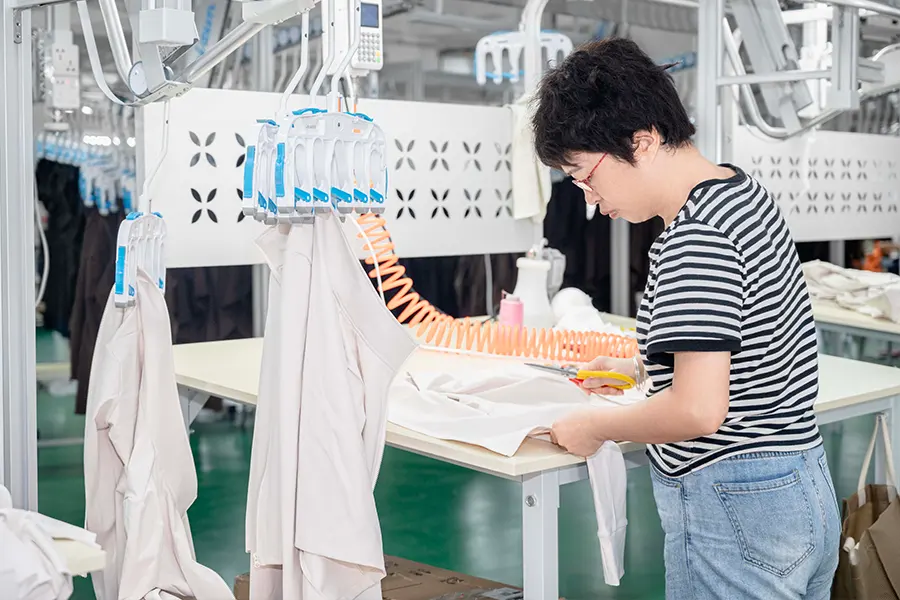
Contract clauses you must include (MOQ, lead-time guarantee, breach & 처벌)
Key contract clauses that must be included in apparel sourcing agreements with Chinese factories are: 최소 주문 수량 (MOQ), Lead-Time Guarantee, and Breach & Penalties. These clauses define minimum purchase obligations, ensure timely delivery, and establish financial consequences for non-compliance, directly impacting cost, supply chain reliability, and risk management.
In our experience working with Chinese apparel factories, clearly drafted clauses on MOQ, lead-time, and breach penalties are essential for maintaining consistent supply and reducing unnecessary risk. Each clause should define obligations, set measurable performance targets, and outline remedies in case of non-compliance.
최소 주문 수량 (MOQ)
MOQ determines the smallest quantity a supplier will accept for production. For sportswear and 퍼포먼스 의류, this typically ranges between 300 그리고 1,000 스타일별 조각, depending on fabric types and factory capacity.
- MOQ clause example: “Buyer shall purchase from Supplier a minimum of [insert quantity] units per [insert time period].”
- Orders beflexible MOQ may be rejected or subject to a minimum charge.
- Failure to meet MOQ may lead to liquidated damages, often calculated as a set percentage of the shortfall.
Lead-Time Guarantee
Timely delivery is critical in apparel sourcing. Standard lead time for apparel production ranges from 30 에게 90 days depending on complexity, order size, and material availability.
- Lead-time clause example: “Supplier guarantees delivery within [insert number] days of order acceptance, with penalty for delays.”
- Typical late delivery penalties range from 0.5% 에게 2% of order value per week.
- Including rolling forecasts improves supplier planning and helps meet deadlines.
Breach and Penalties
Contracts should define consequences for failing MOQ or lead-time commitments in clear financial terms. This ensures fairness to both parties while maintaining production reliability.
- MOQ underperformance can require the buyer to pay damages of 5–20% of the shortfall value.
- Late deliveries may trigger penalties payable by the supplier, calculated per week of delay.
- Persistent breaches can justify converting exclusive agreements to non-exclusive, or ending the contract.
- Well-calibrated penalties incentivize performance without straining supplier relationships.
Critical Perspectives on Contract Clauses
Brands sometimes think MOQ is entirely flexible, but it often depends on fabric minimums and factory schedules. Lead times may fluctuate due to raw material supply, holiday shutdowns, and inspection requirements, so they should be agreed upon with realistic buffers.
- Balance penalties to avoid hidden costs or damaging supplier trust.
- Add force majeure clauses to address uncontrollable delays.
- Use rolling forecasts to improve production timing and planning.
- Regularly review MOQ and lead times for evolving business needs.
Negotiating with Chinese suppliers
Negotiating with Chinese suppliers requires a data-driven approach focused on minimum order quantities (MOQ), production lead times, and clear contract terms to mitigate risks such as PO cancellation and delivery delays. Effective negotiation hinges on understanding prevailing industry benchmarks and leveraging market data to secure favorable terms.
For apparel manufacturing, working directly with Chinese suppliers demands clear metrics, tested negotiation strategies, and accurate market insights. 우리의 경험에 따르면, brands that rely on these factors outperform those leaning only on informal agreements.
Key Contract Terms: MOQ, 리드타임, and Deposits
When negotiating, the MOQ, lead times, and deposit requirements define the commercial baseline. These terms influence cost, 유연성, and production scheduling.
| 📌 Contract Term | Industry Benchmark | Negotiation Insight |
|---|---|---|
| MOQ | 200–1,000 units for small-batch injection molding | 💡 Flexibility possible with reliable forecasts |
| 생산 리드타임 | 20–45 days after deposit, extending to 60+ 날 in peak seasons | 🚀 Plan orders early in Q3/Q4 to avoid delays |
| Deposit | 30%-50% upfront, often non-refundable post-production start | ⚠️ Confirm refund terms before order confirmation |
Risks and Penalty Clauses in Supplier Agreements
Risk management starts with a well-written supplier agreement. Without strong clauses, cost exposure can escalate quickly, especially in high-volume apparel orders.
- PO cancellations after production begins usually forfeit a 30%-50% deposit.
- Late delivery penalties average 0.5%–1% of order value per week, capped at 5%-10%.
- Including delivery guarantees and penalty definitions can minimize impact during seasonal export surges.
Market Data and Negotiation Strategy
Understanding the current market performance strengthens negotiation leverage. China’s October 2025 manufacturing PMI hovered at 50.6, indicating moderate expansion.
Year-on-year growth reached 4.9%, suggesting steady capacity among suppliers. Experienced buyers use this data to push for terms that align with available production resources.
- Negotiate flexible MOQ terms by showcasing credible demand forecasts.
- Secure favorable payment schedules tied to delivery milestones.
- Document every detail in written agreements to protect both parties.
- Conduct regular supplier audits to ensure compliance and quality consistency.
Common Misconceptions About Negotiating with Chinese Suppliers
Mistaken assumptions often limit what buyers achieve in supplier talks. Clearing these misconceptions improves bargaining positions.
- Believing MOQs are fixed — many suppliers grant adjustments with solid demand plans.
- Trusting solely in personal relationships — formal contracts remain essential safeguards.
- Overlooking penalty clauses risks unexpected financial hits.
- Building contingency plans and dispute mechanisms ensures smoother cooperation.
Checklist for U.S./EU buyers
A comprehensive checklist for U.S. and EU buyers sourcing apparel from Chinese factories should include verifying supplier credentials, confirming compliance with international standards, reviewing MOQ and lead time terms, ensuring clear communication protocols, and establishing robust quality control procedures.
When sourcing apparel from Chinese factories, buyers in the U.S. and EU benefit from a structured approach. Following a clear checklist reduces risks, ensures compliance, and improves production stability.
Supplier Verification
우리의 경험에 따르면, confirming a supplier’s legitimacy upfront prevents costly disputes later. Verification should go beyond a simple online search.
- Request business license, factory audit 보고서, and professional references.
- Check for past client testimonials or 사례 연구 to assess reputation.
- Verify physical factory location and production capabilities.
Compliance and Certifications
Factories must meet strict U.S. and EU apparel standards before production begins. These safeguards protect both brand reputation and customer safety.
- Confirm certifications such as ISO, BSCI, 그리고 OEKO-TEX.
- Ensure factory understands and meets U.S. and EU regulatory requirements.
- Verify compliance with environmental and labor safety standards.
MOQ, 리드타임, and Payment Terms
Clear contract terms for MOQ, lead time, and payments help avoid misunderstandings. Negotiating specifics before production ensures smooth operations.
| 📦 Factor | Details |
|---|---|
| MOQ | Typically ranges from 500 에게 5,000 units per style depending on factory capacity. |
| 리드타임 | Standard production runs take 45–90 날, including sampling. |
| Payment Terms | 30% deposit upfront and 70% balance before shipment. |
Communication Protocols
Clear communication avoids costly production errors. Assigning responsibilities early makes updates more reliable.
- ✅ Specify a primary contact person and preferred language for communication.
- ✅ Agree on frequency and format of progress reports.
- ✅ Set expectations to prevent misunderstandings and delays.
Quality Control Procedures
Proactive quality checks reduce the risk of shipment rejections. Quality inspections should be embedded at multiple stages.
- ✅ Implement pre-production quality checks for materials and samples.
- ✅ Conduct in-line inspections during manufacturing.
- ✅ Perform final inspections before shipment to ensure compliance with specifications.
Packaging and Logistics
Proper packaging safeguards products during transit and meets retail requirements. Logistics terms must be clear to define responsibilities.
- ✅ Verify packaging meets export and retail requirements, including labeling.
- ✅ Clarify Incoterms such as FOB, CIF, or DDP to define shipping responsibilities.
- ✅ Confirm preferred shipping methods and required documentation.
Critical Buyer Considerations
Skipping due diligence steps increases risk. These considerations help brands maintain supply chain integrity.
- Neglecting supplier verification can lead to counterfeit or non-compliant products.
- Undefined MOQ and lead times may cause contractual disputes or delays.
- Lack of clear communication often results in misunderstandings affecting product quality and schedules.
- Robust quality control ensures the final product matches buyer expectations and international standards.
Checklist for U.S./EU buyers
Strong apparel sourcing from Chinese factories hinges on aligning MOQ, production lead time, and PO cancellation safeguards with rigorous supplier verification and compliance checks. The strategies outlined — from embedding lead-time guarantees into contracts to maintaining contingency inventory and negotiating data-backed terms — give buyers leverage to secure dependable supply and protect margins. Each tactic works best when integrated into a disciplined procurement framework that considers both market volatility and production realities.
Applying these measures in a unified checklist allows U.S. and EU buyers to minimize risk, preserve product quality, and maintain consistent delivery schedules. Companies that act on these principles position themselves to compete with greater agility, reduce disruption impact, and strengthen long-term supplier partnerships. A trusted manufacturing partner makes executing these steps smoother, enabling teams to focus on scaling product lines and meeting market demand with confidence.