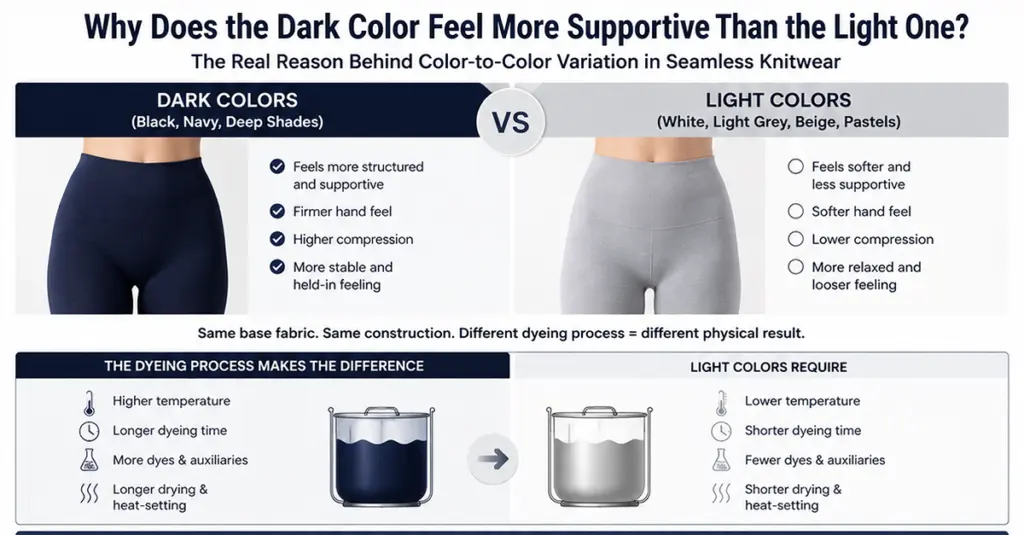
If you’ve ever compared two seamless garments in the same style and noticed the dark navy version feels firmer and more supportive than the light grey one, you’re not imagining it. One of the biggest reasons is seamless garment dyeing.
And no, it’s not necessarily a factory mistake. The dyeing and finishing process can significantly change fabric density, compressione, and overall garment performance.
The Real Reason Behind Color-to-Color Variation in Seamless Knitwear
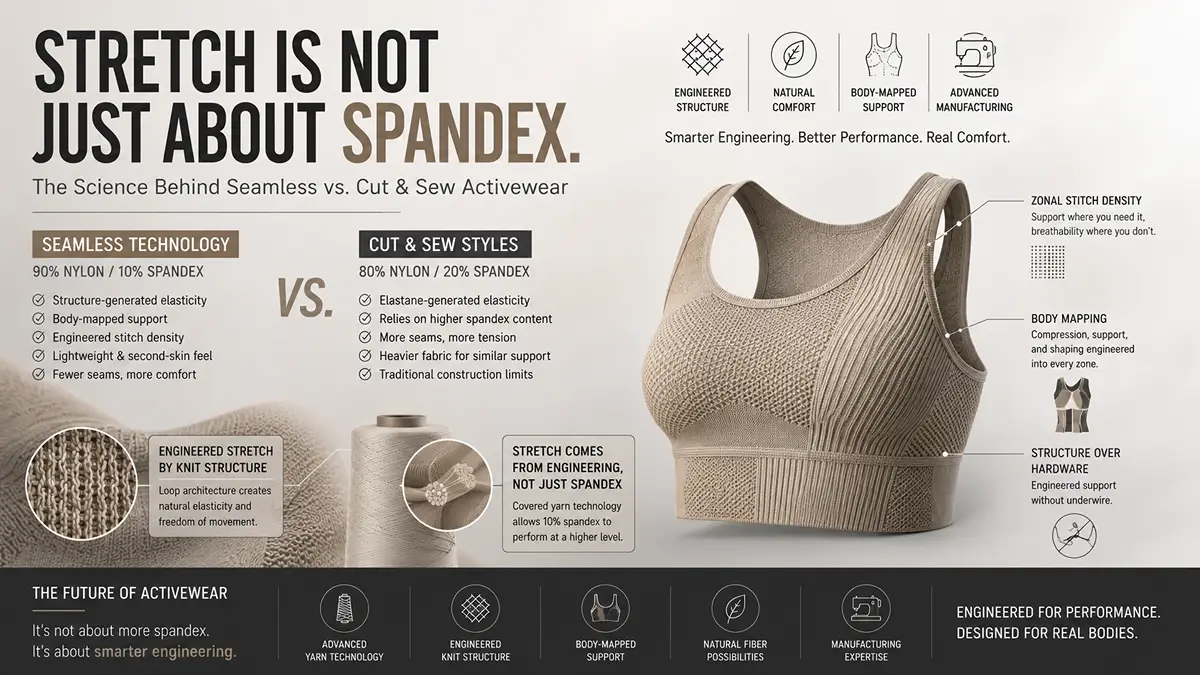
Seamless garments are knitted first as a complete tubular structure, then dyed afterward. That means every colorway begins from the exact same greige base fabric.
But once dyeing begins, the process diverges dramatically depending on color depth.
Dark colors like black, marina, chocolate, or burgundy require:
- longer dye cycles
- higher dyeing temperatures
- more dye chemicals and auxiliaries
- stronger fixation processes
- extended drying and heat-setting
Light colors like white, cream, beige, or light grey go through a much gentler process. The yarn, knitting structure, and machine remain the same, but the finishing conditions are completely different. In seamless products, finishing changes everything.
What Actually Happens to the Fabric During Dark Dyeing
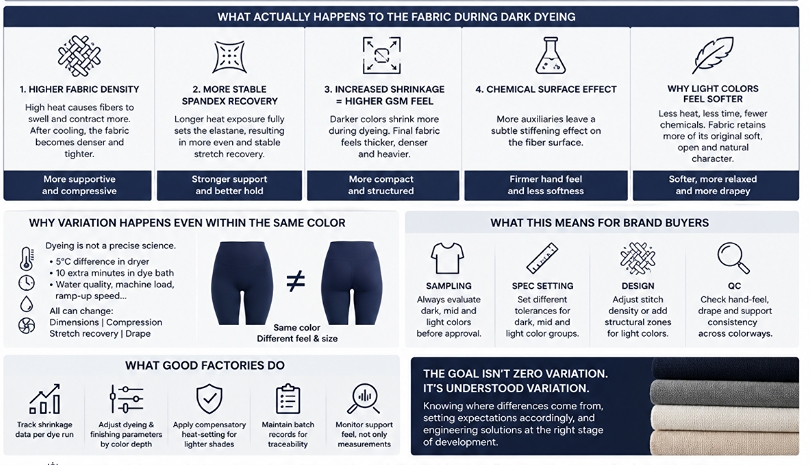
Higher Fabric Density
Longer exposure to heat causes the yarn structure to swell and contract more aggressively.
After cooling, the fabric becomes denser and tighter.
This is why darker seamless garments often feel:
- more compressive
- firmer
- more supportive
- Di più “held together”
More Stable Spandex Recovery
Extended heat-setting stabilizes the elastane more completely.
The stretch recovery becomes more controlled and uniform, which creates the sensation of stronger support.
Increased Shrinkage = Higher GSM Feel
Dark colors usually shrink more during dyeing and drying.
Even when the original greige fabric is identical, the final garment can end up:
- slightly smaller
- denser
- heavier-feeling
- more compact
This changes both fit perception and hand feel.
Chemical Surface Effect
Dark shades require more leveling agents, fixatives, and auxiliary chemicals.
These can subtly stiffen the fabric surface and reduce the “open softness” found in lighter shades.
Why Light Colors Feel Softer
Light shades go through less thermal stress and less chemical processing.
Di conseguenza, they retain more of the original greige fabric character:
- softer hand feel
- more natural drape
- lower perceived compression
- more open stretch behavior
That softness can be desirable for lounge or studio products.
But for high-support seamless leggings or sculpt collections, it often creates complaints like:
“The black feels amazing, but the beige feels loose.”
This is one of the most common return reasons in seamless activewear — especially online.
Why Variation Happens Even Within the Same Color
Even if the color is identical, seamless products can still vary between production batches.
Because dyeing is not perfectly repeatable.
Small process differences can significantly affect the final garment:
- dye bath temperature
- water quality
- machine load ratio
- drying duration
- heat-setting temperature
- ramp-up speed
A difference of:
5°C in drying temperature or 10 extra minutes in heat-setting
Can noticeably change:
- garment dimensions
- compression feel
- recupero dell'allungamento
- drape behavior
This is also why seamless is harder to control than cut-and-sew apparel
In cut-and-sew:
Fabric is dyed first → stabilized → then cut to pattern.
In seamless:
The garment is knitted first → then dyed afterward.
Which means any shrinkage during dyeing directly changes the final size and fit.
What This Means for Brand Buyers
Understanding this isn’t just technical knowledge.
It directly affects:
- fit consistency
- return rates
- soddisfazione del cliente
- product reviews
- reorder stability
To better understand the full system, see our breakdown of Guida alla tintura dei tessuti personalizzata: In che modo i marchi di abbigliamento sportivo raggiungono la coerenza dei colori.
What Experienced Brands Usually Do
Campionamento:
Never approve compression or support based only on dark colors.
Always test at least:
- one dark shade
- one mid-tone
- one light shade
before bulk approval.
Specification Setting
Do not use one tolerance standard for all colors.
Dark, mid, and light shades often require different expectations for:
- restringimento
- GSM
- recupero dell'allungamento
- fit tolerance
Development Strategy
For light-color styles requiring support:
- increase stitch density
- adjust knit tension
- add structural compression zones
- apply compensatory heat-setting
during development.
QC Standards
Good QC is not only measuring dimensions.
It should also include:
- hand-feel consistency
- drape comparison
- stretch recovery evaluation
- compression comparison across colorways
before bulk approval.

What Strong Seamless Factories Actually Do
Experienced seamless manufacturers do not treat every color the same.
They separate finishing parameters based on color depth and fabric behavior.
A technically strong factory will:
- track shrinkage data by dye batch
- adjust heat-setting per color family
- compensate lighter shades during finishing
- maintain batch records for traceability
- monitor support feel, not only measurements
In seamless manufacturing, “same specification” does not always mean”same wearing experience.” The goal is not zero variation, but controlled variation.
Conclusione
Understanding where differences come from allows brands to engineer around them before the customer experiences the problem. And in seamless activewear, this is one of those invisible details that rarely appears in a tech pack — but shows up immediately in customer reviews and return data.
Curious how other brands handle color-to-color consistency in seamless products? Sansansports would love to hear your experience.