You have probably experienced it — your phone slips, bounces, or slowly creeps out of your pocket mid-run. It breaks your focus. It slows you down. アクティブウェアブランドの場合, this small problem is a big opportunity.
Pocket design is one of the most requested and most complained-about features in running wear and yoga wear. Getting it right takes more than just sewing a pouch onto the side seam. It takes careful planning around placement, depth, fabric tension, and entry angle.
This article breaks down the full engineering process behind a truly functional side pocket — the kind that holds your phone snugly against your thigh, stays silent during sprints, and opens easily when you need it. Whether you are building your first activewear line or improving an existing design, this guide gives you the knowledge to make smarter decisions.
The Mechanics of Pocket Design: Run-Ready Storage for Your Phone
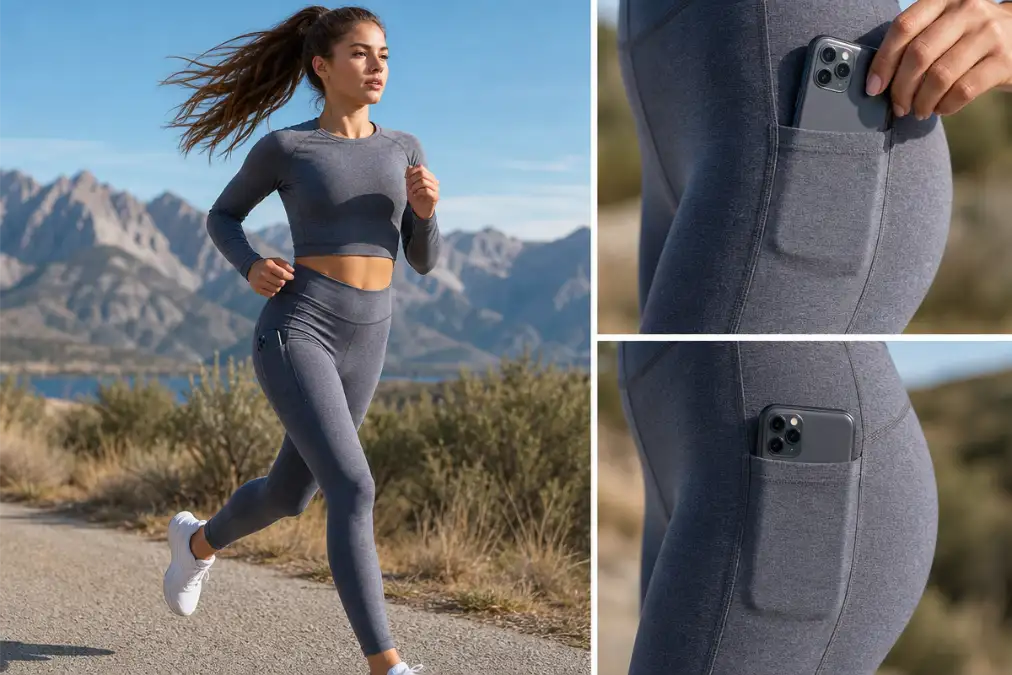
A pocket that works for yoga does not automatically work for running. These are two very different movement patterns. Yoga involves slow, deep stretches and holds. Running involves repetitive impact, bounce, and speed changes.
When your phone sits inside a side pocket during a run, it experiences constant upward and downward force with every stride. If the pocket is too loose, the phone bounces. きつすぎる場合, it is hard to access. If the opening angle is wrong, the phone slides out sideways on a hill.
Good pocket design solves all of these problems together. It is a balance between grip, フィット, access, and structure. Each design decision affects the others. That is why factories with real activewear experience approach pocket engineering as a full system — not just a single panel.
Pocket Placement: Ideal Thigh Zone for Stability
Where the pocket sits on the leg matters more than most brand owners expect. Place it too high, near the hip, and the phone swings outward as the hip rotates. Place it too low, near the knee, and it pulls the fabric down and feels heavy.
The ideal placement is on the outer thigh, roughly between mid-hip and mid-thigh. This zone moves with the leg as a unit. The thigh does not rotate like the hip does. It pushes forward and back in a straight line during running. A phone sitting in this zone stays more stable because it is moving in one direction rather than two.
Placement also depends on the fit of the legging. A tighter compression fit holds the pocket closer to the body. A relaxed fit allows more movement. For running-specific styles, compression fit combined with the thigh zone placement gives the best results.
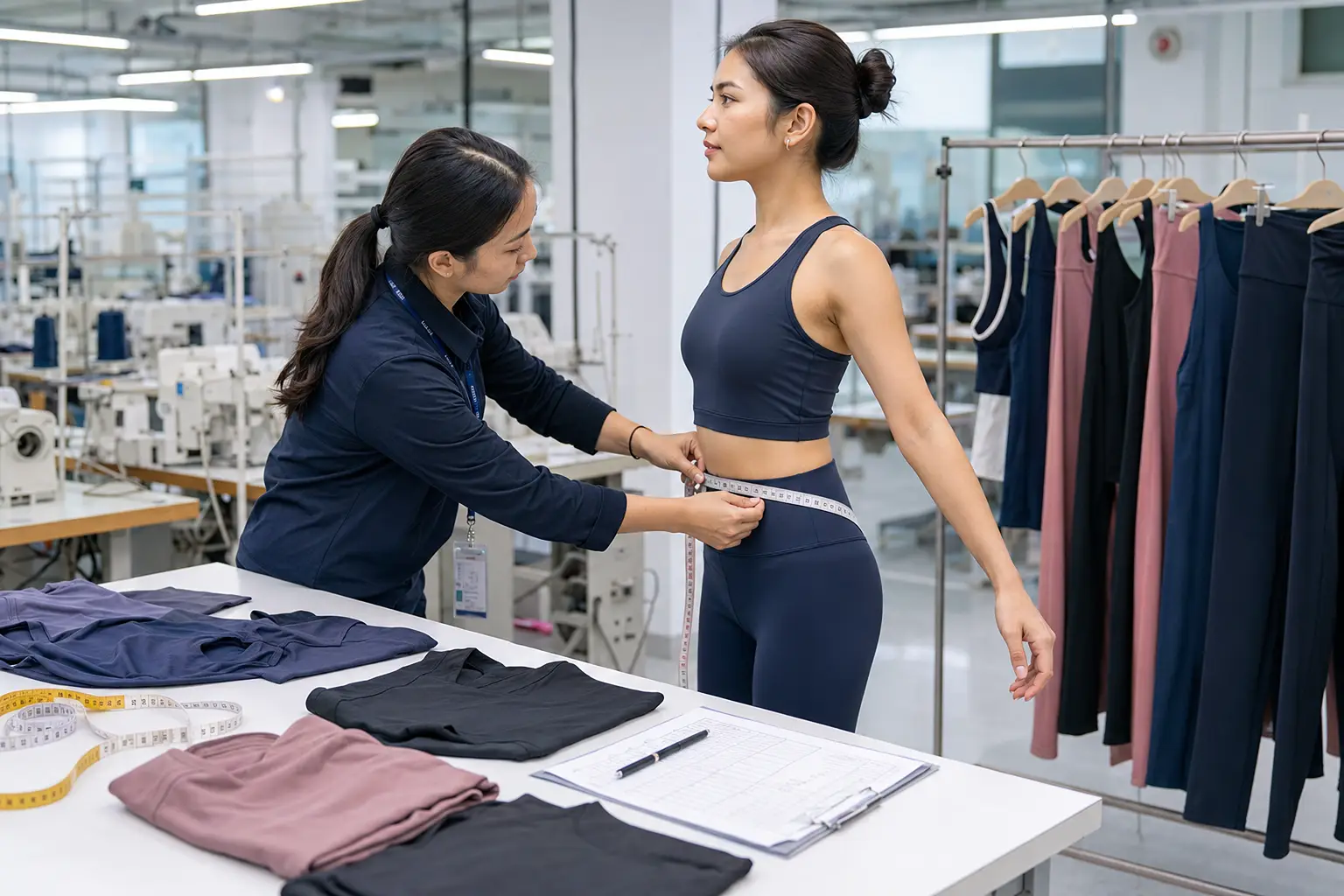
At the factory level, placement is tested across different body measurements before a final position is confirmed. What works on a size small pattern may need adjustment on a size large to maintain the same thigh-zone alignment.
Depth and Angle: Preventing Phone Bounce and Pop-Out
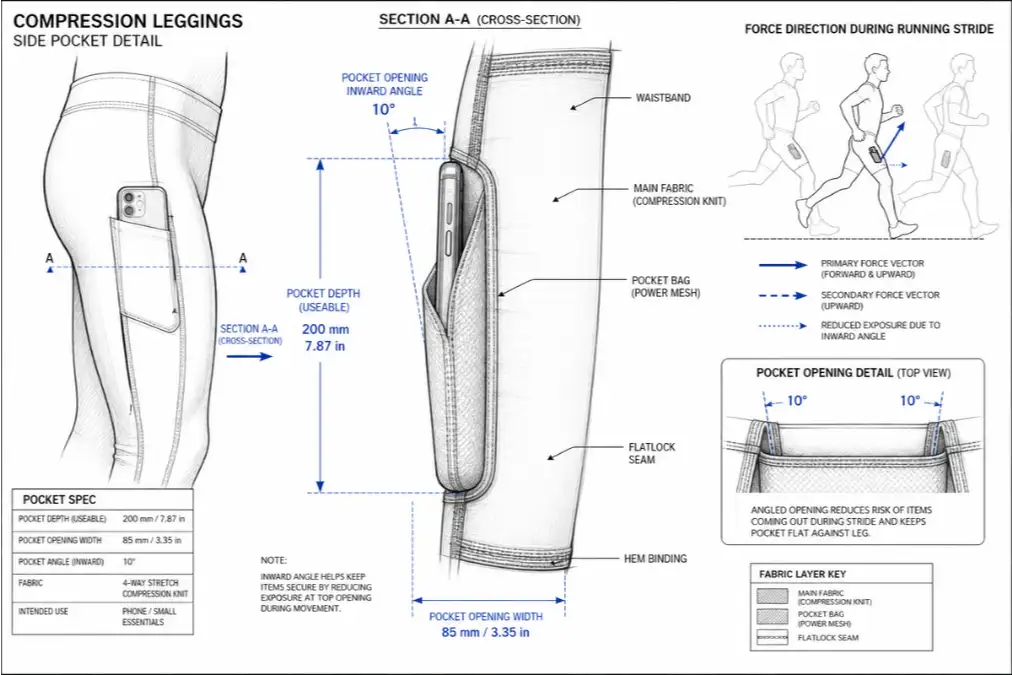
Depth is the distance from the pocket opening to the bottom of the pocket. Most phone pockets are designed for today’s larger smartphones — typically 16 に 18 centimeters deep. But depth alone does not stop bounce.
Angle plays an equally important role. A vertical pocket opening allows the phone to slide straight up when you run — because each stride pushes force upward through the leg. A pocket angled slightly inward, toward the front of the thigh, redirects that upward force into the pocket wall instead. The phone pushes against the fabric rather than pushing toward the opening.
A slight inward angle of five to ten degrees is enough to make a noticeable difference. Combined with proper depth, the phone has nowhere to travel. It sits low, presses inward, and stays put.
This angle also makes the pocket more comfortable. The phone rests flat against the thigh rather than sticking out at the side. Runners often say they forget the phone is even there — which is exactly the goal.
Compression Integration: Using Fabric Tension to Lock In Devices
Fabric tension is one of the most powerful tools in pocket engineering. When the pocket panel is cut from a fabric with controlled compression, it naturally presses inward against the thigh and against whatever is inside the pocket. This constant pressure helps reduce device movement during running, トレーニング, and other high-impact activities.
Several fabric-related factors influence how effectively compression secures a phone inside the pocket:
- 生地重量: A slightly heavier or denser pocket fabric adds structure and improves device retention without restricting natural leg movement.
- 4方向ストレッチ: The pocket must expand easily when a phone is inserted while maintaining comfort and unrestricted mobility during exercise.
- Elastic Recovery: Fabrics that quickly return to their original shape after stretching provide more consistent compression throughout a workout.
- Double-Layer Construction: A matching outer layer combined with a tighter-knit inner compression layer can increase grip on the device while maintaining a seamless appearance.
This combination of compression, ストレッチパフォーマンス, and recovery properties helps create pockets that remain secure throughout demanding physical activity.
Pocket Opening Shape: Entry Ease vs Security Trade-Off
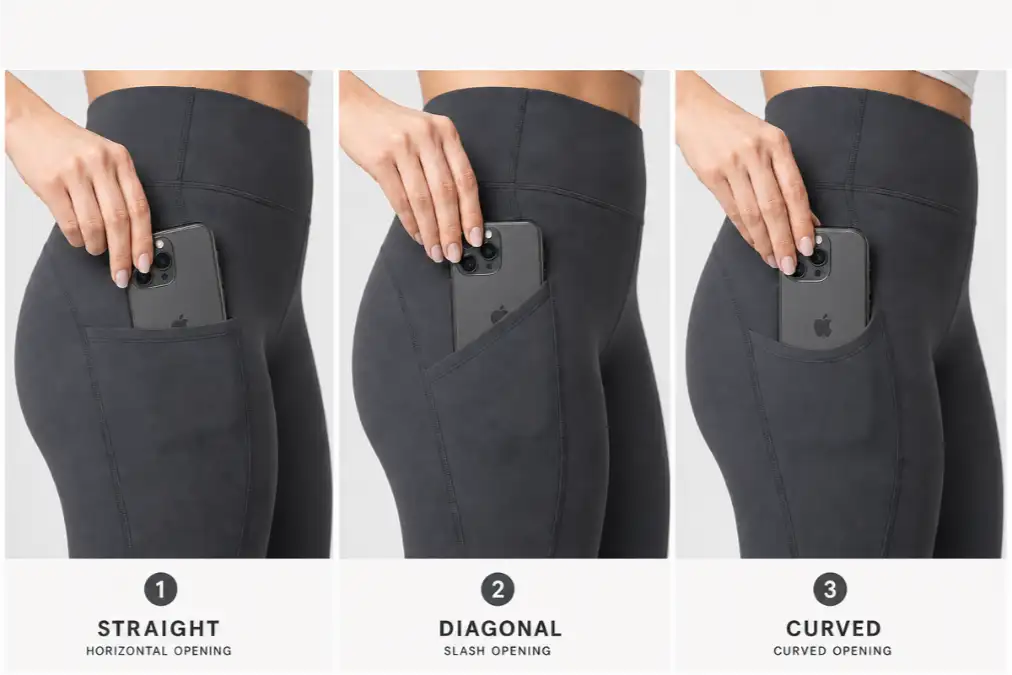
The shape of the pocket opening determines how easy it is to put your phone in — and how likely it is to fall out. These two goals naturally compete with each other. A wide, easy-to-open pocket is less secure. A very secure pocket is harder to use quickly.
The most common opening shapes are:
- Straight horizontal: easy to see and use, but offers less natural closure
- Diagonal slash: angles with the hand movement, feels intuitive, good middle ground
- Curved or crescent: sits naturally against the hip curve, reduces gaping at the top
For running applications, a diagonal slash opening is usually the best choice. It allows quick one-hand access. It also naturally closes under fabric tension when your hand is not inside it, because the angle works against the direction of opening.
Opening width is also important. A phone should slide in with one hand but not fall through on its own. The standard recommendation is to make the opening about 80 percent of the phone’s width. This creates enough resistance to hold the phone without making it frustrating to access.
Lining and Grip: Using Stretch Mesh and Anti-Slip Details
Even a well-placed, well-sized pocket can fail if the inside surface is too smooth. A phone inside a smooth nylon pocket can still shift and bounce because there is nothing to hold it in place.
Stretch mesh lining adds breathability and a light texture that grips the phone naturally. Mesh has a slightly rough surface that creates friction without adding bulk. It also allows airflow, which keeps the pocket from trapping heat against the thigh during long runs.
Some factories add a thin silicone strip or anti-slip print to the bottom or sides of the pocket interior. This is the same technology used in waistbands to prevent leggings from sliding down. Applied inside the pocket, it creates a soft grip point that keeps the phone from vibrating upward.
These details are small in cost but significant in performance. For brand owners developing premium running collections, anti-slip lining is one of the most appreciated features by end customers — and one of the clearest signs of thoughtful product development.
Bounce Testing: Sprint, ジャンプ, and Stair Run Validation
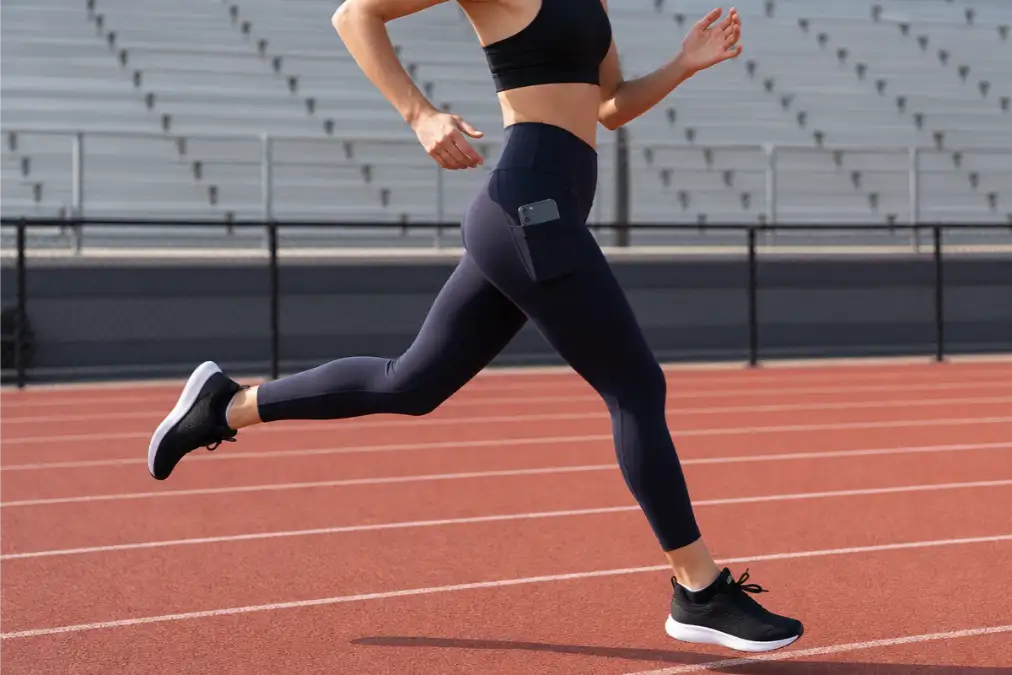
A pocket design is not finished until it passes movement testing. This means putting a real phone inside and running — not walking, not slow jogging, but full-speed sprinting, ジャンプする, and stair climbing.
These three movements stress the pocket in different ways. Sprinting creates rapid vertical impact. Jumping creates a single large vertical force followed by landing impact. Stair climbing combines angle changes with stride variation. A pocket that passes all three is genuinely bounce-free.
In a professional factory setting, fit models wear the test samples during each movement type. Engineers observe phone movement, listen for noise inside the pocket, and check whether the phone changes position after each test. If the phone shifts even slightly during a jump landing, the design goes back for adjustment.
Brand owners developing new styles should always request a physical sample and wear-test it themselves before approving production. No technical drawing fully replaces the real experience of running with a phone in the pocket.
結論
A phone pocket that truly works during running is not an accident. It is the result of intentional decisions made at every stage — placement, depth, angle, fabric tension, opening shape, 裏地, and real-world testing. Each element supports the others.
For startups and brand owners entering the activewear space, pocket design is one of the best places to invest attention early. It is a feature your customers will use every single day. When it works perfectly, they remember your brand. When it fails, they switch.
If you are developing a running legging or any activewear style with side pockets, we are ready to help you engineer it right. Our team works through the full development process — from pattern and fabric selection to prototype testing and bulk production. Reach out to discuss your project, and let us build something that actually performs.
よくある質問
Q1: What phone size should I design the pocket for?
Most brands design for smartphones between 15 そして 16.5 centimeters in height, which covers the majority of current models including larger smartphones. If your target customer uses a specific phone model, you can request a custom pocket depth.
第2四半期: What fabric works best for the pocket panel?
A four-way stretch nylon or polyester with a density slightly higher than the body fabric works well. Fabrics with 80 percent or higher elastic recovery rate hold their shape and grip better over time.
Q3: How do I prevent the pocket from gaping open when empty?
A diagonal opening angle combined with a slightly elastic hem at the opening edge helps the pocket close naturally under fabric tension. Some designs also use a hidden inner elastic loop to hold the pocket closed when empty.
Q4: Can you produce custom pocket designs with anti-slip lining and double-layer panels?
はい. Our factory offers full OEM, ODM, およびMDMDサービス. This includes custom pocket placement, double-layer panel construction, stretch mesh lining, and silicone grip details. We work with brand owners from initial sketch through final bulk production.