Uno de los conceptos más incomprendidos en el desarrollo de ropa deportiva es este:
¿Por qué una prenda sin costuras hecha con:
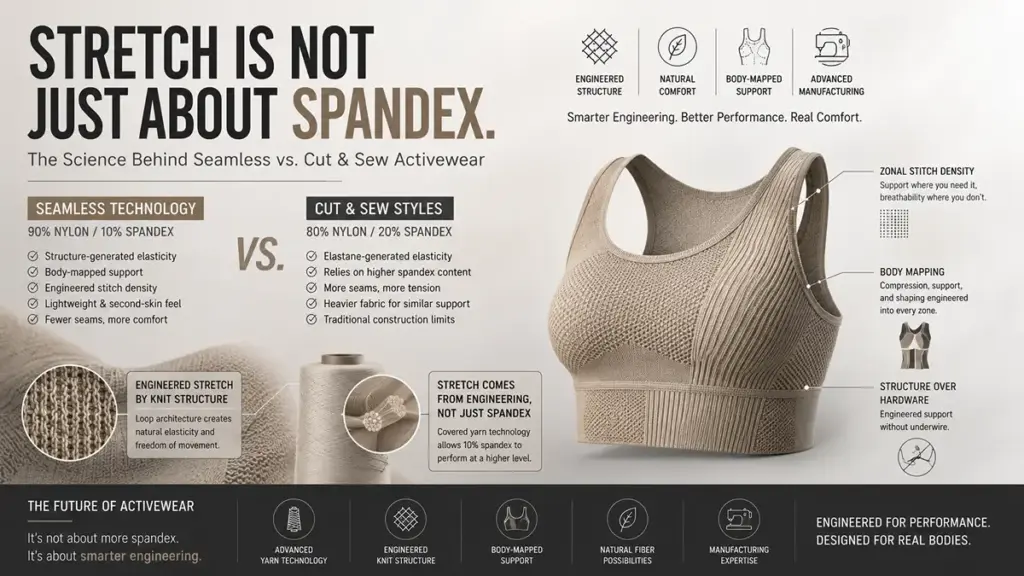
90% nylon / 10% spandex
todavía me siento extremadamente elástico, solidario, y contorno corporal...
mientras que un corte tradicional & coser tela a menudo requiere:
80% nylon / 20% spandex
para lograr un estiramiento y una recuperación comparables en cuatro direcciones?
A primera vista, esto parece contradictorio.
La mayoría de la gente supone: más spandex = más estiramiento.
Pero en realidad, La ropa deportiva de alto rendimiento no depende únicamente de la composición del tejido..
La recta final, apoyo, y la recuperación de una prenda en realidad están determinadas por un sistema mucho más grande:
• Estructura del tejido • Construcción del hilo • Densidad de puntada • Mapeo de compresión • Comportamiento de recuperación • Ingeniería de la prenda • Y cómo participa el elastano dentro de la arquitectura del tejido
Aquí es donde la tecnología perfecta lo cambia todo.
La costura sin costuras no se estira solo gracias al spandex
Los tejidos tradicionales para ropa deportiva y las prendas sin costuras funcionan de forma muy diferente.
La mayoría corta & coser telas dependen de:
"Elastano generado elasticidad".
Pero las prendas sin costuras dependen mucho más de:
"Elasticidad generada por la estructura".
Esa distinción es crítica.
En tejido circular sin costuras., la elasticidad no solo proviene del porcentaje de elastano.
Proviene de la propia estructura de tejido diseñada..
El poder oculto de la estructura de bucle
Las prendas sin costuras se confeccionan bucle a bucle mediante máquinas de tejer circulares como los sistemas Santoni..
Cada bucle tejido crea naturalmente un espacio de expansión, casi como un sistema de resorte..
Esto significa que la prenda puede estirarse mecánicamente a través de la estructura., incluso antes de que se trate de altos porcentajes de elastano.
Por eso una prenda sin costuras con sólo 10% El spandex aún puede sentirse muy flexible y abrazar el cuerpo..
La propia estructura está haciendo parte del trabajo..
El tejido de gran calibre crea elasticidad mecánica
Las máquinas sin costura se construyen en una amplia gama de calibres.
• 14G–22G para mallas de compresión y sujetadores deportivos • 28G–40G para camisetas ligeras y capas como una segunda piel
Los calibres más altos crean:
• bucles más finos • estructuras más ajustadas • transiciones de compresión más suaves • y recuperación más controlada
Esto produce lo que muchos desarrolladores llaman:
"Elasticidad mecánica".
En otras palabras: la prenda se estira debido al comportamiento de tejido diseñado, no solo por el contenido de elastano.
Por qué el hilo cubierto lo cambia todo
Otro factor importante es la construcción del hilo..
La mayoría de las prendas sin costuras utilizan:
• hilo de una sola capa • o hilo de doble capa
Esto significa que el elastano se envuelve directamente dentro de los sistemas de hilo de nailon..
Incluso si la composición de la prenda dice
90% nylon / 10% spandex
— contado al nivel del hilo revestido, con el núcleo de elastano típicamente más bajo -
El elastano sigue participando activamente en cada recorrido del hilo dentro de la prenda..
Esto crea una distribución de tensión muy diferente en comparación con el corte tradicional. & coser telas.
En nuestro artículo se explica cómo las fábricas verifican este equilibrio entre estiramiento y recuperación en las prendas terminadas. Guía de prueba de estiramiento de pantalones de yoga..
¿Por qué cortar? & Coser a menudo necesita 20% Spandex
Corte tradicional & Las telas para coser ropa deportiva generalmente se basan en:
• tejidos entrelazados • construcciones de punto doble • telas cepilladas • estructuras de punto por urdimbre
Estos tejidos no tienen el mismo sistema de expansión de bucles diseñado que las prendas sin costuras..
Entonces, en lugar de depender de una arquitectura tejida, Dependen mucho más directamente del propio elastano para estirarse..
Por eso el corte de alta compresión & coser telas a menudo necesitan
15–20% elastano
para lograr
• fuerte estiramiento en cuatro direcciones • ajuste al cuerpo • compresión • y recuperación rápida
Sin suficiente elastano, estas telas pueden sentir:
• rígido • pesado • restrictivo • o lento para recuperarse
La tecnología perfecta se trata realmente de mapeo corporal
Aquí es donde el desarrollo fluido se vuelve verdaderamente poderoso.
Los modernos sistemas integrados permiten a los ingenieros controlar:
• zonas de compresión • áreas de malla transpirable • estructuras de soporte • modelado del contorno • zonas de sudoración • y recuperación de tensión
todo dentro de una sola prenda.
Por ejemplo:
• Tejido de mayor densidad alrededor del busto para brindar soporte • Mapeo de compresión alrededor de la cintura • Estructuras de elevación alrededor de los glúteos • Ventilación de malla abierta en la espalda
esto se llama:
"Densidad de puntada zonal variable".
El soporte proviene de una estructura de ingeniería, no de agregar más peso a la tela o más elastano..
Por qué a muchas marcas premium les encantan las costuras
La tecnología perfecta ofrece varias ventajas:
1. Peso más ligero
Estiramiento fuerte con porcentajes de elastano más bajos..
2. Sensación de segunda piel
Menos costuras y contacto corporal más suave..
3. Mejor contorno corporal
El soporte se puede programar directamente en la estructura de tejido..
4. Fricción reducida
Menos costuras significa menos irritación.
5. Mayor barrera técnica
El desarrollo continuo y avanzado requiere un profundo conocimiento de ingeniería, no solo capacidad de costura.
Pero la costura fluida también tiene limitaciones
A pesar de sus ventajas, La fluidez no siempre es la solución perfecta..
Algunos desafíos incluyen:
• Flexibilidad limitada de la tela • Variación de color más sensible después del teñido • Mayor complejidad de desarrollo para un tamaño de busto más completo • Mayor costo de configuración de la máquina • Y mayores desafíos al usar fibras naturales
Este último punto es especialmente importante.
Las fibras naturales como el algodón tienen una recuperación más débil en comparación con los hilos sintéticos de alto rendimiento..
Entonces construyendo: soporte inalámbrico + comodidad natural + recuperación perfecta
es uno de los desafíos más difíciles en la ingeniería de indumentaria moderna en la actualidad..
El futuro de la ropa deportiva puede pasar del “tejido elástico” a la “ingeniería estructural”
Durante años, La industria de la ropa deportiva se ha centrado en gran medida en:
• mayor contenido de spandex • compresión más ajustada • tejidos sintéticos de alto rendimiento
Pero la próxima generación de desarrollo de prendas de vestir puede ser muy diferente.
El futuro puede construirse alrededor:
• estructuras de tejido diseñadas • sistemas de soporte mapeados en el cuerpo • comodidad de fibras naturales • arquitectura de hilo centrada en la recuperación • y mapeo de compresión inteligente
No simplemente "más spandex".
Y es exactamente por eso que la tecnología sin costuras continúa evolucionando mucho más allá de los conjuntos básicos de yoga o la ropa deportiva..
Es posible que el futuro de la indumentaria deportiva no esté cosido.
Puede diseñarse directamente en la propia estructura..
—
En DEPORTES SANSANSUN, Hemos pasado mucho tiempo investigando sistemas materiales., ingeniería de densidad de puntada, mapeo corporal sin costuras, y el equilibrio entre comodidad, apoyo, y recuperación, y ayudar a las marcas a convertir esa investigación en estilos listos para producción a través de nuestra ODM sin fisuras & Servicio OEM.
porque al final, Los mejores productos nunca se crean solo con tela..
Se crean por la integración de: Material + Estructura + Construcción + Adaptar + Ingeniería.